
Dryer Vent Cleaning Bayswater NY: How to Avoid Common Mistakes
Dryer lint buildup is more than a housekeeping issue. A restricted dryer exhaust can reduce airflow, increase drying times, and create conditions that increase fire risk. The National Fire Protection Association estimated an average of 13,820 home structure fires involving dryers each year from 2014 through 2018. Failure to clean was a contributing factor in about 32 percent of those fires.
For homeowners in Bayswater and Far Rockaway, regular maintenance starts with understanding the entire exhaust system rather than focusing only on the lint screen. The dryer, transition duct, exhaust duct, and exterior termination all matter. Here are the mistakes to avoid when arranging dryer vent cleaning.
Before You Start: Understand Your Dryer Vent System
Before cleaning begins, identify where the dryer exhaust terminates outside the home.
The exhaust system should carry dryer moisture and air to the outdoors. Under the 2024 International Residential Code, dryer exhaust ducts must terminate outside the building, with requirements for the termination and backdraft damper. Screens are not permitted at the dryer exhaust termination because they can restrict airflow and collect lint.
The exact route varies from home to home. Do not assume that every Bayswater property has the same duct configuration or that a particular route is common throughout the neighborhood.
If you cannot identify the exterior termination, tell the technician before cleaning begins. A professional can help trace the exhaust path and determine whether the installation can be properly accessed.
Step 1: Do Not Assume the Lint Screen Is Enough
Cleaning the lint filter is essential, but it does not replace cleaning the dryer exhaust system.
The U.S. Fire Administration recommends cleaning the lint filter before and after each cycle. It also advises homeowners to check the venting system behind the dryer for damage, crushing, or restrictions.
Lint can also accumulate in the exhaust duct. One warning sign is a dryer that takes substantially longer than usual to dry clothes.
If loads that previously dried normally now require much more time, check the lint filter, airflow, exterior termination, and exhaust duct. Do not assume that the dryer itself is simply getting old.
Step 2: Understand the Full Exhaust Run
The entire exhaust path matters, not just the short section immediately behind the dryer.
The 2024 International Residential Code requires dryer exhaust ducts to have a smooth interior finish and generally specifies a 4-inch nominal duct. It also limits the length of the exhaust system according to the applicable method, with reductions for certain fittings. Manufacturer instructions can also determine the allowable size and length.
This means a long duct run is not automatically unsafe simply because it exceeds a particular number of feet. The allowable configuration depends on the dryer manufacturer’s instructions, duct design, fittings, and applicable code requirements.
During a professional cleaning, the technician should identify the accessible portions of the duct system and look for restrictions, crushed sections, disconnected joints, or other problems that could interfere with airflow.
Step 3: Ask How the Vent Will Be Cleaned
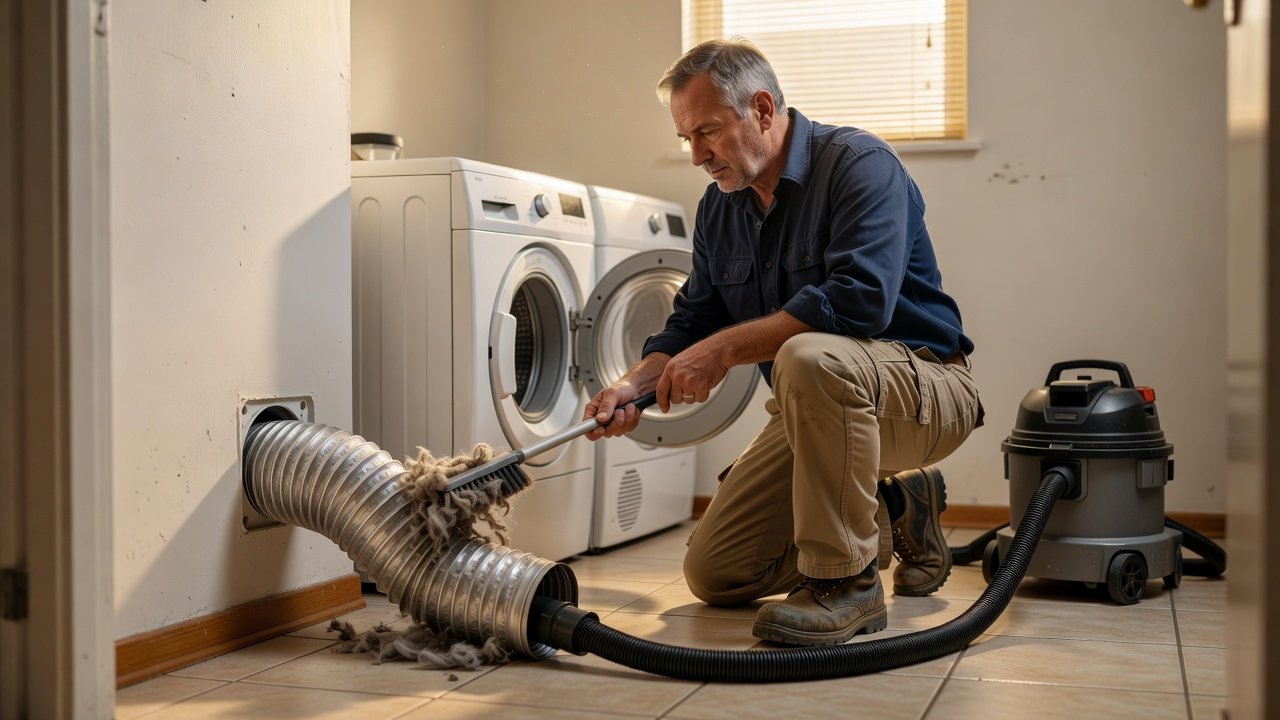
A professional dryer vent cleaning should address the exhaust duct rather than simply vacuuming the lint immediately around the dryer.
Different systems may require different cleaning equipment. Rotary brush systems, air-based systems, and specialized vacuum equipment can all be used depending on the duct configuration and the technician’s approach.
The important question is whether the cleaning method can effectively remove accumulated lint throughout the accessible exhaust system.
Ask the company:
-
What equipment do you use?
-
Will you clean the full accessible duct?
-
Will you check the exterior termination?
-
Will you inspect the transition duct?
-
How will you verify that airflow has improved?
Do not choose a company based solely on whether it advertises one particular type of equipment.
Step 4: Check the Exterior Termination
The outside termination is an important part of the system.
The 2024 International Residential Code requires dryer exhaust terminations to be located outside and equipped with a backdraft damper. Screens are not permitted at the termination.
A professional should check whether the termination is blocked by lint, debris, nesting material, or other obstructions. The damper should also be able to operate properly.
If the exterior termination is damaged or incorrectly configured, cleaning the duct alone may not solve the underlying problem.
Step 5: Inspect the Transition Duct Behind the Dryer
The short section connecting the dryer to the permanent exhaust duct deserves attention.
Current code requires a transition duct to be listed and labeled for dryer use. The 2024 IRC limits a transition duct to 8 feet and prohibits it from being concealed within construction.
The transition duct should not be crushed or sharply kinked behind the appliance.
Do not automatically assume that every flexible transition duct is prohibited. The key distinction is whether the product is specifically listed and labeled for dryer transition use and installed according to the applicable requirements.
The permanent exhaust duct itself is subject to different requirements, including smooth interior construction.
Step 6: Know When Cleaning May Be Needed Again
There is no universal cleaning interval that applies to every household.
The U.S. Fire Administration recommends cleaning dryer vent ductwork annually as part of home fire safety guidance.
However, the appropriate maintenance schedule can depend on the dryer, household usage, duct configuration, airflow, and the condition of the system.
Instead of automatically scheduling service every eight or ten months because a household has a certain number of loads, pay attention to changes in dryer performance.
Warning signs include:
-
Clothes taking longer than usual to dry
-
The dryer or clothing becoming unusually hot
-
Little airflow at the exterior termination
-
A damaged or crushed transition duct
-
Lint accumulating around the dryer
-
A vent termination that does not open properly
-
Visible lint or debris at the exterior outlet
If these problems appear, have the exhaust system evaluated.
What If Cleaning Does Not Fix Slow Drying?
A professional cleaning does not guarantee that every dryer performance problem will disappear.
If drying remains slow afterward, the problem could involve the dryer itself, a restricted or improperly configured exhaust system, a disconnected section, or another mechanical issue.
A duct inspection may help determine whether the exhaust system is intact. In some situations, additional diagnostic equipment may be appropriate.
Do not assume that a slow dryer automatically means there is mold inside the wall. A disconnected or improperly terminated exhaust can create moisture problems, but that needs to be established through an actual inspection.
What About Long Dryer Vent Runs?
Long exhaust runs require particular attention because airflow resistance increases as the system becomes longer or contains additional fittings.
The 2024 IRC provides a maximum specified exhaust duct length of 35 feet before deductions for certain fittings when that calculation method is used. However, the code also allows the dryer manufacturer’s installation instructions to determine the applicable size and maximum length.
Therefore, homeowners should not use “25 feet” as a universal maximum for every dryer.
If your dryer is located far from an exterior wall, ask a professional to evaluate the complete duct configuration rather than simply measuring the distance.
How to Choose a Dryer Vent Cleaning Company in Bayswater
Before hiring a company, ask what the service includes.
A good checklist is:
-
Confirm that the company cleans the exhaust duct.
-
Ask whether the exterior termination will be inspected.
-
Ask whether the transition duct will be checked.
-
Ask what cleaning equipment will be used.
-
Ask whether the technician will identify damaged or disconnected sections.
-
Request a written explanation of any recommended repairs.
-
Ask whether the company is insured and properly qualified for the work.
Do not choose a contractor simply because the advertised price is the lowest. The scope of dryer vent cleaning can vary depending on accessibility and the condition of the system.
Dryer Vent Cleaning Bayswater NY: The Important Part
Getting a dryer vent cleaned is not simply a matter of removing lint from the area immediately behind the appliance.
The entire exhaust system matters. The lint filter needs regular cleaning. The transition duct should be appropriate for dryer use and properly installed. The permanent exhaust duct should meet applicable requirements. The exterior termination needs to remain unobstructed and able to discharge air outdoors.
For homeowners in Bayswater and Far Rockaway, the safest approach is to have the system evaluated when drying times increase, airflow decreases, or the venting system shows visible problems. Regular maintenance can also help identify restrictions before they become a larger issue.
Related from Far Rockaway Chimney: Chimney Cleaning in Far Rockaway, NY · Creosote Removal in Far Rockaway, NY – Professional Chimney Cleaning & · Chimney Repair in Far Rockaway, NY – Restore Safety & Structural I